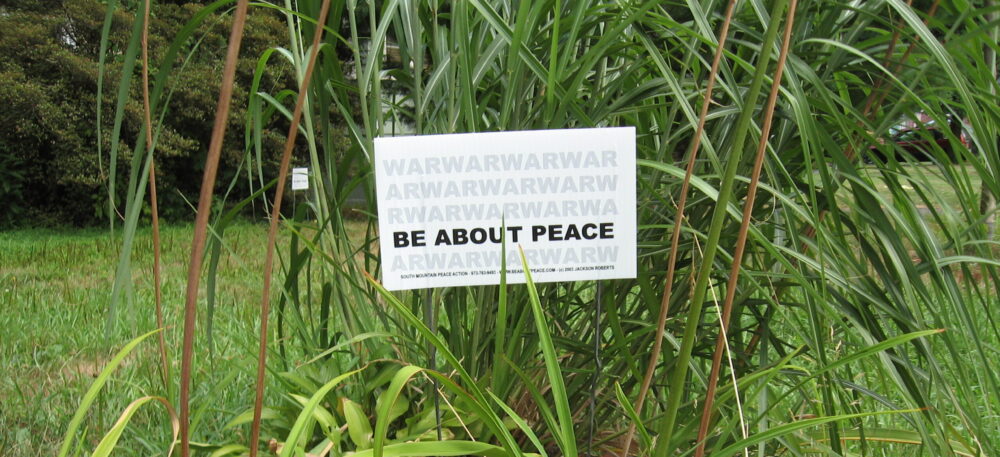
 SMPA’s “Be About Peace Day” template appears on Cities for Progress. Maplewood and South Orange peace proclamations appear on this page and here and here. For Maplewood’s 2003 antiwar resolution, click here
Category Archives: SpecialNotices
Maplewoodstock July 11-12, 2009

Department of Peace Campaign
We support the Department of Peace campaign.
Ron Paul Gives Antiwar Speech at Southern Republican Leadership Conference
Congressman Ron Paul gave an antiwar speech at the conference on April 10, 2010, and then was voted second place (one vote behind first place) by the Republican activist attendees in the Presidential straw poll. Here is an excerpt of his speech:
“No matter how badly you would like to have them, all empires end, not because they’re defeated militarily. All empires end for financial reasons and that is what the markets are telling us today.
“Besides, if you want a strong national defense, it should be designed for defense, not to support preventative wars and not to support wars that are undeclared. Don’t you think it’s rather conservative to say, ‘Oh, it’s good to follow the Constitution except for war! Let the Presidents go to war anytime they want!’.
“I would say that if you want go to war, only Congress can declare the war. Declare the war, know who the enemy is and go fight and win it and get out of there!
“And also, politically, it’s much easier and it makes a lot more sense to cut the militarism and the bases overseas than it is to cut child welfare here at home. There’s just so much room for that and I don’t hesitate for a minute because I know we would be stronger for it.”
“…Twenty years, the French and the Americans trying to tell the Vietnamese how to be westernized totally failed at a fantastic, horrible cost to us and now we have won more in peace than we have ever won in war because they’re trading partners, we travel over there, their president comes over here, we can do better with peace than with war.”
South Mountain Peace Action Sends Letter to Congress with 1,337 Signatures

Photos deleted from homepage 4-18-10


Maplewood Rally with MoveOn
Protests Bush Veto of Iraq Timetable
May 2, 2007

On May 1, 2007, President Bush vetoed the Iraq Accountability Act (HR 1591) which included a timeline to withdraw US troops from Iraq by March 31, 2008. More than 100 people protested the veto at the Maplewood Town Hall rally.
Click to see more Photos: 1 :: 2 :: 3
Afghanistan
[ Draft ] A Citizens’ Proposal for Peace in Afghanistan
South
Mountain Peace Action supports the following steps to improve the
prospects for peace in Afghanistan and enable our troops to come home as
soon as possible.1 A Presidential Timetable for Withdrawal of US Troops
President Obama
should issue a plan to carry out a timetable for the safe, orderly and
expeditious redeployment of US armed forces from Afghanistan, as called
for by House Resolution 5015 by Rep. James McGovern and by Senate
Resolution S3197 by Senator Russ Feingold.
We urge consideration of the
following steps, recommended by military and civilian experts, to
improve the prospects for improved security, development and human
rights, as we redeploy our troops from Afghanistan:
2. Redefine Our Mission in Afghanistan
The US should rebrand its mission in Afghanistan to carrying out the United Nations mandates
which call for military and civilian assistance to help the Afghan
people improve their security, rebuild their country and protect human
rights, especially for women. The current emphasis on our mission as
“defeating” Al Qaeda suggests a military victory, which virtually
everyone, including General Petraeus, agrees is impossible.
3. Avoid Civilian Casualties and Minimize Military Casualties
The US should strengthen its policy of avoiding civilian casualties by stopping drone attacks
which Colonel David Kilcullen says victimize innocents and are
counterproductive and which the ACLU says are violations of US
Constitution and international law. We should also prioritize military actions to minimize our military casualties as well as civilian casualties.
Securing urban areas instead of attacking Taliban strongholds, is a
priority suggested by Gilles Dorronsoro of the Carnegie Endowment for
International Peace
4. Press Pakistan to End its Safe Haven and Weapons Flow to the Taliban
The US should continue to press
Pakistan to eliminate the safe haven, the flow of weapons and any other
form of support for the Taliban from its territory.
5. Negotiate With the Taliban but Require Acceptance of Human Rights, Especially for Women
The US should support Afghan
Government efforts to negotiate with the Taliban on reconciliation and
reintegration, but this should be conditioned on respect for basic human
rights, especially for women, as recommended by Human Rights Watch in its July 2010 report
on Afghanistan. Negotiations with the Taliban on power-sharing, as
proposed by Gilles Dorronsoro, also protecting human rights, especially
for women, should also be considered.
Government efforts to negotiate with the Taliban on reconciliation and
reintegration, but this should be conditioned on respect for basic human
rights, especially for women, as recommended by Human Rights Watch in its July 2010 report
on Afghanistan. Negotiations with the Taliban on power-sharing, as
proposed by Gilles Dorronsoro, also protecting human rights, especially
for women, should also be considered.
____________________________
For additional background information on the War in Afghanistan, click the following links:
Women Today in Taliban-Controlled Areas: Human Rights Watch Report July 2010
Letter of Resignation of Captain Matthew Hoh
US Economic Assistance to Afghanistan
How the US supported the rise of extreme Islamic groups
in Afghanistan, including Al Qaeda and the Taliban
MoveOn Cost of War Report
Released in Maplewood Aug 16th
Click here for the report’s conclusions and photos.
SMPA: US Timetable to Withdraw from Agfhanistan
South Mountain Peace Action: End the War in Afghanistan. The United States should adopt a timetable to withdraw its troops from Afghanistan like its timetable in Iraq.
How a Timetable Can Be Carried Out: Documents: Documents, Proposals and Opinions
The Iraq Study Group
Human Rights Watch
Proposal by SMPA Chair Paul Surovell
http://www.afghanistanstudygroup.org/
IRAQ STUDY GROUP PROPOSAL
A NEW WAY FORWARD
Our proposal will improve security for Americans and reduce annual costs by at least $60 billion per year.
1. Emphasize power-sharing and political inclusion.
The U.S. should fast-track a peace process designed to decentralize power within Afghanistan and encourage a power-sharing balance among the principal parties.
2. Downsize and eventually end military operations in southern Afghanistan, and reduce the U.S. military footprint.
The U.S. should draw down its military presence, which radicalizes many Pashtuns and is an important aid to Taliban recruitment.
3. Focus security efforts on Al Qaeda and Domestic Security.
Special forces, intelligence assets, and other U.S. capabilities should continue to seek out and target known Al Qaeda cells in the region. They can be ready to go after Al Qaeda should they attempt to relocate elsewhere or build new training facilities. In addition, part of the savings from our drawdown should be reallocated to bolster U.S. domestic security efforts and to track nuclear weapons globally.
4. Encourage economic development.
Because destitute states can become incubators for terrorism, drug and human trafficking, and other illicit activities, efforts at reconciliation should be paired with an internationally led effort to develop Afghanistan’s economy.
5. Engage regional and global stakeholders in a diplomatic effort designed to guarantee Afghan neutrality and foster regional stability.
Despite their considerable differences, neighboring states such as India, Pakistan, China, Iran and Saudi Arabia share a common interest in preventing Afghanistan from being dominated by any single power or being a permanently failed state that exports instability to others.
AMERICA’S INTEREST
The central goal of U.S. foreign and defense policy is to ensure the safety and prosperity of the American people. In practical terms, this means deterring or thwarting direct attacks on the U.S. homeland, while at the same time maintaining the long-term health of the U.S. economy. A sound economy is the foundation of all national power, and it is critical to our ability to shape the global order and preserve our core values and independence over the long-term. The United States must therefore avoid an open-ended commitment in Afghanistan, especially when the costs of military engagement exceed the likely benefits.
What is at Stake in Afghanistan?
The United States has only two vital strategic interests in Afghanistan. Its first strategic interest is to reduce the threat of successful terrorist attacks against the United States. In operational terms, the goal is to prevent Afghanistan from again becoming a “safe haven” that could significantly enhance Al Qaeda’s ability to organize and conduct attacks on the United States.
The United States drove Al Qaeda out of Afghanistan in 2002, and Al Qaeda’s presence in Afghanistan is now negligible. Al Qaeda’s remaining founders are believed to be in hiding in northwest Pakistan, though affiliated cells are now active in Somalia, Yemen, and several other countries. These developments suggest that even a successful counterinsurgency campaign in Afghanistan would have only a limited effect on Al Qaeda’s ability to conduct terrorist attacks against the United States and its allies. To the extent that our presence facilitates jihadi recruitment and draws resources away from focused counter-terror efforts, it may even be counterproductive.
The second vital U.S. interest is to keep the conflict in Afghanistan from sowing instability elsewhere in Central Asia. Such discord might one day threaten the stability of the Pakistani state and the security of Pakistan’s nuclear arsenal. If the Pakistani government were to fall to radical extremists, or if terrorists were able to steal or seize either a weapon or sufficient nuclear material, then the danger of a nuclear terrorist incident would increase significantly. It is therefore important that our strategy in Afghanistan avoids making the situation in Pakistan worse.
Fortunately, the danger of a radical takeover of the Pakistani government is small. Islamist extremism in Pakistan is concentrated within the tribal areas in its northwest frontier, and largely confined to its Pashtun minority (which comprises about 15 percent of the population). The Pakistani army is primarily Punjabi (roughly 44 percent of the population) and remains loyal. At present, therefore, this second strategic interest is not seriously threatened.
Beyond these vital strategic interests, the United States also favors democratic rule, human rights, and economic development. These goals are consistent with traditional U.S. values and reflect a longstanding belief that democracy and the rule of law are preferable to authoritarianism. The U.S. believes that stable and prosperous democracies are less likely to threaten their neighbors or to challenge core U.S. interests. Helping the Afghan people rebuild after decades of war is also appealing on purely moral grounds.
Yet these latter goals, however worthy in themselves, do not justify a costly and open-ended commitment to war in Afghanistan. Afghanistan remains one of the poorest countries in the world and is of little intrinsic strategic value to the United States. (Recent reports of sizeable mineral resources do not alter this basic reality.) Afghan society is divided into several distinct ethnic groups with a long history of conflict, it lacks strong democratic traditions, and there is a deeply rooted suspicion of foreign interference.
It follows that a strategy for Afghanistan must rest on a clear-eyed assessment of U.S. interests and a realistic appraisal of what outside help can and cannot accomplish. It must also take care to ensure that specific policy actions do not undermine the vital interests identified above. The current U.S. strategy has lost sight of these considerations, which is why our war effort there is faltering.
WHAT’S WRONG WITH THE CURRENT U.S. STRATEGY?
President Obama has repeatedly said that we are fighting in Afghanistan in order to prevent the country “from becoming an even larger safe haven from which Al Qaeda would plot to kill more Americans.”5 Since taking office, Obama has committed nearly 50,000 additional troops to an ambitious counterinsurgency campaign designed to oust the Taliban from the areas it controls, win the confidence of the local population, train effective Afghan security forces, and help create a competent, legitimate, and effective central government.
Unfortunately, this counterinsurgency-based nation-building strategy rests on a flawed understanding of the strategic stakes, and it undercuts our broader strategic goals.
First, the decision to escalate the U.S. effort in Afghanistan rests on the mistaken belief that victory there will have a major impact on Al Qaeda’s ability to attack the United States. Al Qaeda’s presence in Afghanistan today is very small, and even a decisive victory there would do little to undermine its capabilities elsewhere. Victory would not even prevent small Al Qaeda cells from relocating in Afghanistan, just as they have in a wide array of countries (including European countries).
Second, a U.S. drawdown would not make Al Qaeda substantially more lethal. In order for events in Afghanistan to enhance Al Qaeda’s ability to threaten the U.S. homeland, three separate steps must occur: 1) the Taliban must seize control of a substantial portion of the country, 2) Al Qaeda must relocate there in strength, and 3) it must build facilities in this new “safe haven” that will allow it to plan and train more effectively than it can today.
Each of these three steps is unlikely, however, and the chances of all three together are very remote. For starters, a Taliban victory is unlikely even if the United States reduces its military commitment. The Taliban is a rural insurgency rooted primarily in Afghanistan’s Pashtun population, and its seizure of power in the 1990s was due to unusual circumstances that no longer exist and are unlikely to be repeated. Non-Pashtun Afghans now have ample experience with Taliban rule, and they are bound to resist any Taliban efforts to regain control in Kabul. Moreover, the U.S. military presence has helped the Taliban rally its forces, meaning that the group may well fragment and suffer a loss of momentum in the face of a U.S. drawdown. Surveys suggest that popular support for the Taliban among Afghans is in the single digits.
Even with significantly reduced troop levels, we can build a credible defense against a Taliban takeover through support for local security forces, strategic use of airpower, and deployment in key cities without committing ourselves to a costly and counterproductive COIN (counterinsurgency) campaign in the south. And if power-sharing and political inclusion is negotiated, the relevance of the Taliban as an alternative to Kabul is likely to decline.
And even if the Taliban were to regain power in some of Afghanistan, it would likely not invite Al Qaeda to re-establish a significant presence there. The Taliban may be reluctant to risk renewed U.S. attacks by welcoming Al Qaeda onto Afghan soil. Bin Laden and his associates may well prefer to remain in Pakistan, which is both safer and a better base from which to operate than isolated and land-locked Afghanistan.
Most importantly, no matter what happens in Afghanistan in the future, Al Qaeda will not be able to build large training camps of the sort it employed prior to the 9/11 attacks. Simply put, the U.S. would remain vigilant and could use air power to eliminate any Al Qaeda facility that the group might attempt to establish. Bin Laden and his associates will likely have to remain in hiding for the rest of their lives, which means Al Qaeda will have to rely on clandestine cells instead of large encampments. Covert cells can be located virtually anywhere, which is why the outcome in Afghanistan is not critical to addressing the threat from Al Qaeda.
In short, a complete (and unlikely) victory in Afghanistan and the dismantling of the Taliban would not make Al Qaeda disappear; indeed, it would probably have no appreciable effect on Al Qaeda. At the same time, dramatically scaling back U.S. military engagement will not significantly increase the threat from Al Qaeda.
Third, the current U.S. military effort is helping fuel the very insurgency we are attempting to defeat. An expanded U.S. presence has reinforced perceptions of the United States as a foreign occupier. Religious extremists have used the U.S. presence as an effective recruiting tool for their cause. Efforts to limit civilian casualties and other forms of collateral damage have been only partially successful, leading additional Afghans to take up arms against us.
Fourth, the expanded U.S. presence and a more energetic counterinsurgency effort in Afghanistan and Pakistan have reinforced a tacit alliance among different extremist groups whose agendas are not identical. The Taliban is itself a loose coalition of Pashtuns, many of whom are motivated by local concerns rather than by any deep commitment to global jihad. Al Qaeda, by contrast, is a global network of radical Islamists seeking to topple governments throughout the Middle East. The “Pakistani Taliban” are a separate alliance of different Islamist groups challenging the authority of the Pakistani state. The Haqqani network in Waziristan is led by a local warlord who is strongly opposed to foreign interference but reportedly also a sometime ally of Pakistan’s Inter-Service Intelligence agency (ISI).
Although cooperation among these disparate groups has increased in recent years, this development is largely a reaction to the increased foreign presence in the region and our efforts to convince the Pakistani government to take more aggressive action against these groups. Thus, our current strategy is helping drive these groups together, when our real aim should be to drive wedges between as many of them as possible and to win over those who do not share Al Qaeda’s anti-Western agenda or its commitment to global jihad.
Fifth, keeping 100,000-plus U.S. troops in yet another Muslim country lends credence to jihadi propaganda about America’s alleged hostility to Islam. Their presence may actually be increasing the overall danger that we face back home. Anger at U.S. military action in the Af/Pak theater inspired Faisal Shahzad, a U.S. citizen, to attempt an unsuccessful car bomb attack in Times Square, and other home-grown terrorists appear to have been inspired by similar motivations.
Sixth, our military strategy is failing because the prerequisites for success do not exist. We have no way of forcing the Taliban to sit still and fight us out in the open—where they would be easy to defeat—because they can melt away into the countryside or withdraw across the Pakistani border whenever they are confronted by superior force. Adding still more troops will not solve this problem, as it would require a much larger force than the United States has available and would generate even more local resentment.
Successful counterinsurgency efforts also require an effective local partner, and the Karzai government in Kabul is anything but. President Karzai has had nearly six years to build a legitimate and minimally effective government, and he has manifestly failed to do so. His re-election last year was marred by widespread fraud. Karzai has been unable or unwilling to crack down on corruption or rein in the warlords on whom his government still depends. The Afghan army and police remain unreliable. The large security forces we are trying to stand up will cost more to maintain than the Afghan government can afford.
Finally, the rising costs of the war in Afghanistan also include opportunity costs. The war in Afghanistan has already consumed a considerable amount of President Obama’s time and attention, at a time when the United States faces many domestic and international challenges. If the United States remains bogged down there, other challenges will receive inadequate attention and could easily get worse. We have an interest in approaching these challenges in a manner that does not encumber our ability to deal with other states in the region – like Iran.
For all these reasons, the Study Group is convinced that current U.S. strategy cannot achieve core U.S. interests at an acceptable cost. Protecting our vital interests requires a fundamentally different approach.
THE COST OF THE AFGHANISTAN WAR
With the Afghanistan Surge, the U.S. will be spending almost $100 billion per year in Afghanistan, with a stated primary purpose of eradicating just 20 to 30 Al Qaeda leaders, and in a country whose total GDP is only $14 billion per annum. This is a serious imbalance of expenses to benefit.
* $100 billion per year is more than the entire annual cost of the Obama administration’s new health care plan and is money that could be used to better counter global terrorist threats, reduce the $1.4 trillion annual deficit, repair and modernize a large portion of U.S. infrastructure, radically enhance American educational investment, launch a massive new Manhattan Project-like effort on energy alternatives research, or be used for other critical purposes.
*The U.S. military budget has grown from $370 billion in 2000 to $707 billion in 2011, and the current Middle East war is now the second most expensive war in U.S. history, behind only World War II. The war is more expensive than the Vietnam and Korean Wars combined. It is now the longest war in U.S. history.
A NEW WAY FORWARD: A FIVE-POINT APPROACH
The Study Group believes that the U.S. strategy in Afghanistan should aim at realistic and attainable objectives. The strategy should become less reliant on military force in favor of a focus on political inclusion, economic development, and regional diplomacy. The United States and its allies must recognize that they cannot dictate Afghanistan’s political future, and—more importantly—that it is not necessary for them to do so to realize their core strategic interests. Accordingly, the Study Group recommends a new strategy comprised of the following five elements:
1) Emphasize Power-Sharing and Political Reconciliation. Afghanistan will not achieve a sustainable peace without broader support from the Afghan people themselves. Accordingly, the United States should fast track a peace process designed to decentralize power within Afghanistan and to encourage a power sharing arrangement among all parties.
Under the current Afghanistan Constitution, the President has unchecked authority to appoint provincial governors and hundreds of other positions in government. As David Miliband wrote, in many parts of the country, district governance is almost nonexistent, half the governors do not have an office, fewer than a quarter have electricity, and some receive only six dollars a month in expenses. As an important start to reform, the Afghan Parliament should be given confirmation authority for major appointments, district councils should be elected, budgeting authority decentralized, and elected provincial representatives should be included in the national level council that determines the portion of funds distributed. The ethnic base of the Afghan army should be broadened. More generally, governance should depend more heavily on local, traditional, and community-based structures.
In contrast to President Karzai’s recent and narrowly conceived “peace jirga,” political outreach should include leaders selected by key tribal and village leaders in all of Afghanistan’s ethnic and regional divisions, including rural Pashtuns. This effort should be open to those among the fragmented Taliban who are willing to engage in genuine reconciliation, a step that can help marginalize those Taliban who remain defiant. Preconditions for negotiations, such as recognizing the existing Afghan Constitution, should not be required.
2) Scale Back and Eventually Suspend Combat Operations in the South and Reduce the U.S. Military Footprint. Simultaneous to these efforts at achieving a new, more stable political equilibrium in the country, the U.S. should downsize and eventually discontinue combat operations in southern Afghanistan. The U.S. needs to draw down its military presence, which radicalizes many Pashtuns and often aids the Taliban’s recruitment effort.
The Study Group recommends that President Obama firmly stick to his pledge to begin withdrawing U.S. forces in the summer of 2011—and earlier if possible. U.S. force levels should decline to the minimum level needed to help train Afghan security forces, prevent massive human rights atrocities, resist an expansion of Taliban control beyond the Pashtun south, and engage in robust counter-terrorism operations as needed. We recommend a decrease to 68,000 troops by October 2011, and 30,000 by July 2012. These residual force levels should be reviewed as to whether they are contributing to our broader strategic objectives in the fall of 2012 – and if not, withdrawn in full over time.
This step would save the U.S. at least $60 billion to $80 billion per year and reduce local resentment at our large and intrusive military presence.
3) Keep the Focus on Al Qaeda and Domestic Security. The U.S. should redirect some part of the savings from this troop reduction toward improved counter-terrorism efforts and protecting U.S. citizens from terrorist attacks. Special forces, intelligence assets, and other U.S. capabilities should continue to seek out and target known Al Qaeda cells in the region. They can be ready to go after them should they attempt to relocate elsewhere. The Study Group also believes that more effort should be made to exploit potential cleavages among different radical groups in the region, a goal that would be facilitated as the U.S. military presence declines.
4) Promote Economic Development. Afghanistan is one of the world’s poorest countries, and endemic poverty has made some elements of the population susceptible to Taliban overtures. Moreover, failed and destitute states frequently become incubators for terrorism, drug and human trafficking, and other illicit activities. Therefore, efforts at reconciliation should be coupled with a broad internationally-led effort to promote economic development. Potentially useful measures include:
Giving Afghanistan preferential trading status with the U.S., Europe, Japan and other leading global economies.
Promoting investment in local and national infrastructure by national and international companies.
Providing subsidies, loans, and technical assistance to local (non-poppy) agricultural producers, construction companies, and artisans.
Promoting “special reconstruction zones” for foreign and domestic companies to produce export goods. Such zones could offer investors preferential tax treatment and access to enhanced security and infrastructure measures, at least initially.
Helping Afghan women directly through micro-lending and educational support programs, and by making some portion of U.S. assistance conditional on the protection of basic human rights, especially women’s rights.
Considering the purchase of Afghanistan’s poppy crop, to give Afghan farmers immediate economic gains, reduce Taliban revenues, and reduce the flow of illicit narcotics to the West.
To the extent possible, external assistance should be channeled through a more decentralized Afghan government. Such decentralization would build capacity, give legitimacy to the government itself, enhance transparency, and limit corruption. Decentralization ensures that aid monies go directly to helping Afghans rather than to consultants, NGOs, and other international agencies.
5) Engage Global and Regional Stakeholders. The Afghanistan conflict reflects long-standing rivalries among the different ethnic and tribal groups within the country, but it has long been exacerbated by outside powers seeking to protect or advance their own interests.
The United States now bears a growing share of the costs of this conflict, even though virtually all of Afghanistan’s neighbors have larger and more immediate stakes in its resolution. Despite their considerable differences, neighboring states such as India, Pakistan, China, and Iran share a common interest in preventing Afghanistan from either being dominated by any single power or remaining a failed state that exports instability.
Accordingly, the Study Group recommends that the substantial reduction in the U.S. military role be accompanied by an energetic diplomatic effort, spearheaded by the United Nations and strongly backed by the United States and its allies. This initiative should seek a formal commitment to Afghan neutrality and a resolution of existing border disputes. They need agreements to recognize and support the more inclusive and decentralized Afghan government described above. The United States should also use its influence to reduce tensions among the various regional actors—and especially India and Pakistan—in order to decrease their tendency to see Afghanistan as an arena for conflict or to view the Taliban or other non-state groups as long-term strategic assets.
The United States should also place greater reliance on allies and partners whose ability to work with Afghans exceeds ours. Non-Arab Muslim states such as Indonesia and Turkey—the latter a NATO ally that is already present on the ground—could play substantial “mentoring” roles in the areas of education, political reform, and human rights. Such states could help Afghanistan conform to international standards as well as their own principles.
Abandoning a predominantly military focus could actually facilitate a more energetic diplomatic effort. As long as the U.S. military is doing the heavy lifting against the Taliban, the Karzai government has no immediate need to broaden its base. Other states can free-ride on the U.S. effort, and regional actors can pursue their own agendas at less risk. Once the U.S. signals that its patience is not infinite and that its military campaign is winding down, then both contenders for power within Afghanistan and Afghanistan’s neighbors will have a greater incentive to negotiate agreements designed to stabilize the situation.
Above all, these five broad measures, which can be translated into action through an integrated planning process, must be pursued with a keen eye toward what is possible and with a clear sense of the costs and benefits. The Study Group is under no illusions about the difficulty of this task and urges U.S. policymakers to adopt a realistic sense of what can be achieved. Specifically:
It is not possible to eliminate all extremist groups from this region, but it is possible to significantly reduce the danger they pose.
It is beyond our capacity to dictate Afghanistan’s political future, but we can help move Afghanistan’s leaders toward political arrangements that are consistent with past traditions and with our own minimum goals.
Afghanistan will not become a stable and flourishing society in short order, but international support can still have positive effects on the lives of its citizens.
A diplomatic agreement resolving all the tensions and rivalries that currently exist in the region is highly unlikely, but the United States can help negotiate more stable arrangements than presently exist.
CONCLUSION
The United States should by no means abandon Afghanistan, but it is time to abandon the current strategy that is not working. Trying to pacify Afghanistan by force of arms will not work. A costly military campaign there is more likely to jeopardize America’s vital security interests than to protect them. The Study Group believes that the United States should pursue more modest goals that are both consistent with America’s true interests and far more likely to succeed.
Additional citations, references and information can be found at our website www.afghanistanstudygroup.com.
__________________________